
A History of the Utah Shakespeare Festival—Celebrating 65 Years!
By Kathryn Neves, guest writer
Celebrating 65 years of magic at the Utah Shakespeare Festival this year has been marvelous! From world-class productions to educational outreach, the Festival is a cornerstone of Cedar City—and of Utah’s cultural arts scene. There have been a lot of milestones over the years—here’s just a few major moments that shaped the Festival into the cultural landmark it is today.
The Dream Begins (1960)
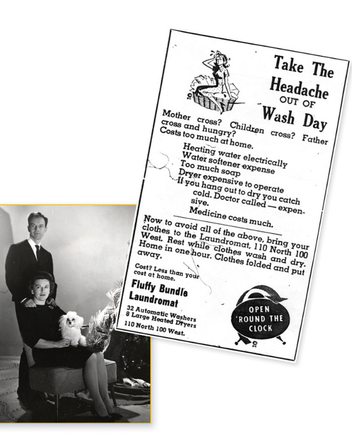
Fiancés Fred Adams and Barbara Gaddie spent one afternoon doing laundry together at Cedar City’s Fluffy Bundle Laundromat. And, while doing their laundry, they brainstormed. Fred had visited the Oregon Shakespeare Festival the year before; and, as the College of Southern Utah’s only theatre professor, he was inspired by their vision and innovation.
Now, in the Fluffy Bundle, Fred and Barbara wondered about the possibility of a Shakespeare Festival in Utah. Cedar City was the perfect place; after all, every summer an estimated quarter of a million tourists visited the nearby national parks. They’d need something to do in the evenings, wouldn’t they? Why not theatre? Why not Shakespeare?
As they waited for their laundry to dry, they wrote down notes on a little yellow notepad—notes that formed the foundation for a theatre company in their own little town of Cedar City, Utah.
Opening Night of the Festival (1962)
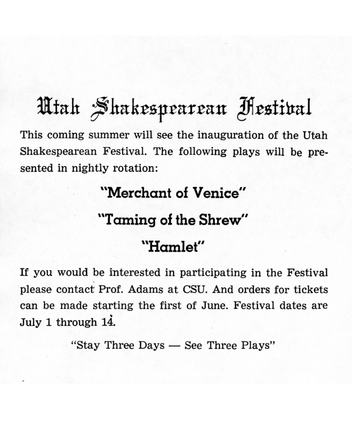
In 1961, Fred directed a student production of The Taming of the Shrew. It was a test season; a proof of concept to see if there was any community interest in a Shakespeare Festival. This proto-season was successful. Fred and Barbara had a year to drum up support for the Festival’s inaugural season.
Students and community members built a simple outdoor stage, along with costumes and props. They put together three shows: The Taming of the Shrew (a repeat of the previous year), The Merchant of Venice, and Hamlet. Barbara Gaddie designed The Greenshow, a way to immerse the audience into the Tudor world before the plays. And, with a $1,000 loan from the local Lions Club, they launched the very first season on July 2, 1962.
When he first approached the Chamber of Commerce in town about the Festival, “the idea went over like a pregnant pole vaulter,” Fred would repeat over the years that followed. But these fears were unfounded. Audiences loved the Festival—enough for Fred and Barbara to continue on the next year, and the next, and the next.
Dedication of the Adams Theatre (1977)
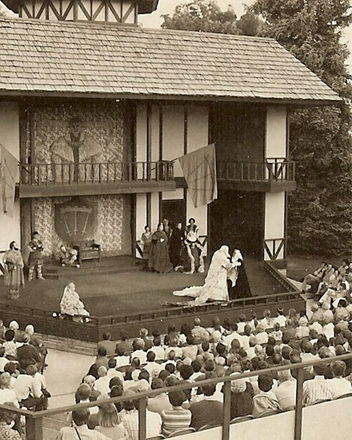
As the years passed, it became clear that the temporary stage on the grass was no longer sufficient. The Festival needed a permanent theatre. Based on 1969 designs by Doug Cook, a plan was created: an Elizabethan, Tudor-style theatre among the red rocks of Iron County. It would be as close as they could get to a replica of Shakespeare’s own Globe Theatre in London.
Construction began in the mid-70s, first with the building of the tiring house and the lower seats, and eventually the addition of the upper balcony. In 1977 the Adams Memorial Shakespearean Theatre—named for Thomas and Luella Adams, the parents (and parents-in-law) of donors Grace and O.C. Tanner—was dedicated.
The theatre was a huge hit. Audiences loved sitting in this beautiful space; it felt like Shakespeare himself could be sitting in the audience, or reciting on that Tudor stage. It was so authentic, in fact, that the BBC would later select it as a filming location for a television program about William Shakespeare.
The Inaugural High School Shakespeare Competition (1977)
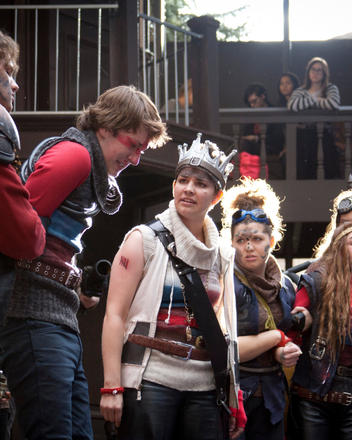
Very quickly, the Festival realized that it could expand its programming. They could make a difference—not just in the lives of the community, but in the lives of students. The educational power of Shakespeare and live theatre was undeniable. So, in the summer of 1977, the Festival hosted the first ever High School Shakespeare Competition. Students from six local schools gathered together to perform Shakespeare, compete against each other, and learn from world-class theatre professionals.
Now known simply as the Shakespeare Competition (or Shakes Comp, by the staff), the program has grown exponentially. As of 2025, the competition has grown to include more than 3,000 students from 107 schools, welcoming students not just from Utah but states all over the Southwest and Pacific Coast, and not only from high schools, but from elementary and middle/junior high schools, and after-school programs too. And not only do the students participate in acting or technical theatre, but also music and dance inspired by Shakespeare.
Groundbreaking for the Randall L. Jones Theatre (1987)
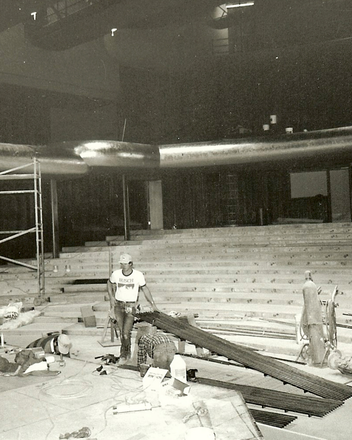
After more than two decades, the Festival realized it had outgrown its single theatre. They needed a new space; something more modern, where they could perform the works of “Shakespeares of other lands.” Musicals, contemporary plays, and new works—all of these needed a new type of theatre.
In 1987 ground was broken on this new theatre. It would be indoor, rather than outdoors, and would feature a gold-leafed balcony and state-of-the-art stage technology systems. After two years of construction, the Randall L. Jones Theatre was dedicated on June 23, 1989—marking a turning point in the evolution of the Festival.
The Regional Theatre Tony Award (2000)
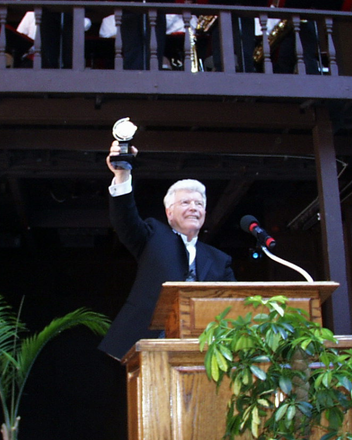
On May 8, 2000, the American Theatre Wing and The Broadway League presented the Utah Shakespearean Festival with the coveted Tony Award—the highest honor in American Theatre. The award was for Best Regional Theatre: a special recognition of the Festival’s quality work and its impact on the community and region.
A group of Festival staff and board, including Fred C. Adams and R. Scott Phillips, accepted the award onstage in New York City and brought it back to Cedar City. A procession of local community members followed the group all the way from the airport to the Festival grounds; the Tony made its way onto the Adams stage, where Fred gave a speech thanking the patrons, artists, and community. Today, the award, normally housed in a display case inside the Randall Theatre lobby, can be seen at the brand new Museum of Utah at the State Capitol in Salt Lake City for the next few years.
Passing the Leadership Torch (2005)
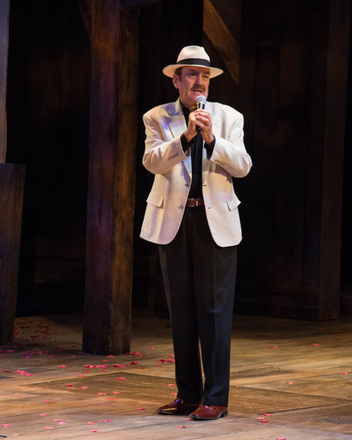
After 44 years as the Executive Director of the Festival, Fred Adams stepped down, passing the torch to R. Scott Phillips, who in the 1970s became the Festival’s first full-time employee. During his tenure as Executive Director, Scott led the Festival through a period of unprecedented growth, including a name change (going from “Shakespearean” to “Shakespeare”) and the fundraising and building of a new campus.
After stepping down in 2017, Scott would go on to serve on Cedar’s City Council where he is currently still a councilman, continuing his tireless efforts to help Cedar City grow and thrive.
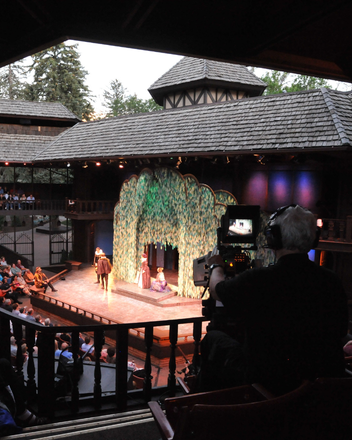
Emmy Award Recognition (2011)
The Festival’s 2011 production of A Midsummer Night’s Dream during its 50th anniversary season was directed by Fred Adams and proved to be a community favorite. With this in mind, a television production team filmed and broadcast the production airing it on the BYUTV channel to audiences all over Utah. It is, to date, the only full Festival performance to be broadcast.
The Festival was awarded a regional Emmy for this production, further recognition of the high caliber of its work. This award can also be viewed in the Randall lobby.
Farewell to the Adams Theatre (2015)
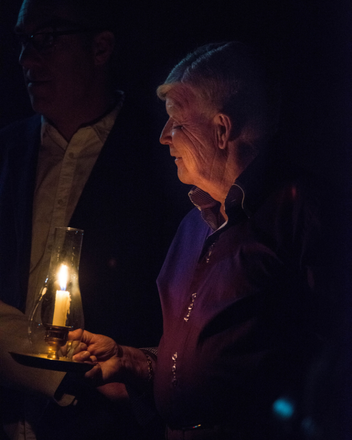
After 38 years of use, the Adams Theatre held its closing performance on September 5, 2015. Audience members, Festival staff, and the actors from the night’s performance of Henry IV Part Two all said goodbye to this beloved and historic building. From here, Fred Adams carried a lit candle from the Adams stage to the construction site of the new campus across the street—carrying on the Festival’s tradition of excellence and theatre magic.
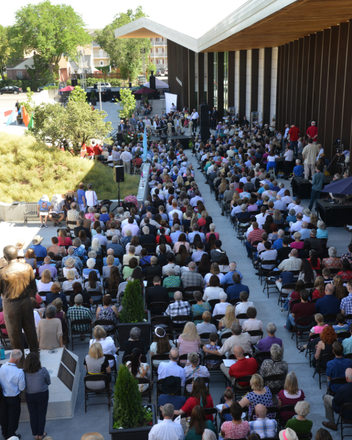
A New Artistic Center is Dedicated (2016)
In 2016, the Festival completed its most ambitious project to date—the Beverley Taylor Sorenson Center for the Arts, a complex including the Randall L. Jones Theatre, the Festival administration offices, The Greenshow stage, and two new theatres—the outdoor Engelstad Shakespeare Theatre and the intimate Anes Studio Theatre—as well as the Southern Utah Museum of Art.
With the same Elizabethan spirit as the original and the addition of modern and state-of-the-art amenities, the new campus provided the Festival with ample space to expand and create, bringing its world-class productions to its beloved community and countless new audiences every year.
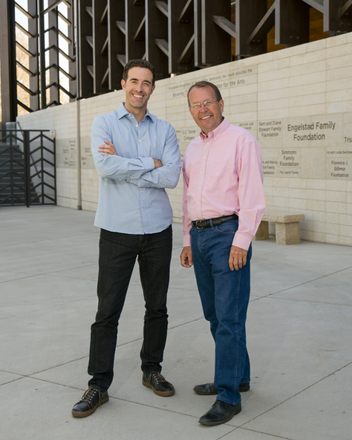
New Leadership Team (2023)
After the departure of R. Scott Phillips in 2017, as well as his successor Frank Mack, the Utah Shakespeare Festival announced Michael Bahr as the new Executive Managing Director. Michael had already been with the Festival for decades, having started out in the Ticket Office while a college student and eventually becoming the Education Director for over twenty years, where he shared his passion and dedication through outreach and student programs. Already a beloved Festival figure, he was a natural choice for this new position.
The Festival also brought on John DiAntonio as the Artistic Director, a newcomer to the Festival, and well-established in the theatre world from his work at Creede Repertory Theatre in Colorado. His work here as Artistic Director, as well as his performance as Petruchio in The Taming of the Shrew and Jack in Ken Ludwig’s Dear Jack, Dear Louise and his direction of Macbeth and Twelfth Night since his arrival, has made him a favorite among Festival patrons.
A Double Anniversary Milestone (2026)
This year, the Festival celebrates two anniversaries: 65 years since that original season back in the sixties, and 10 years since the opening of the Beverley Center for the Arts. While the Festival’s aesthetic and operations have evolved over the past six decades, the same spirit of artistry, sustainability, innovation, and community continues to drive everything it does.
The Festival has grown from its origins, from a small student-led experiment into a thriving world-class theatre. Its decades of history are a testament to the hardworking artists and professionals who have built it into the beloved institution it is today.
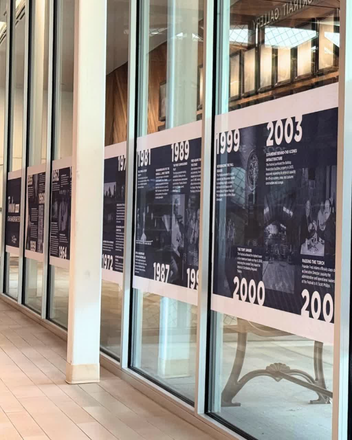
To see a more detailed timeline, visit the Festival’s Portrait Gallery hallway near the Engelstad Theatre to see a new commemorative history display featuring all the amazing milestones over the years, as well as decades of portraits representing the work on Festival stages. You can also now enjoy the Portrait Gallery online at bard.org/portrait-gallery.
Looking Towards the Future
While the past six and half decades have brought countless successes, challenges, memories, milestones, relationships, and growth opportunities, we at the Festival could not be more grateful to be a part of the Festival today, and looking forward to all that lies ahead for this amazing organization. We are so grateful and appreciative to our friends, donors, patrons, and supporters who have helped us grow in so many different capacities throughout our history. To that we say “Thanks, and thanks, and ever thanks” (Twelfth Night, Act 3 Scene 3).