
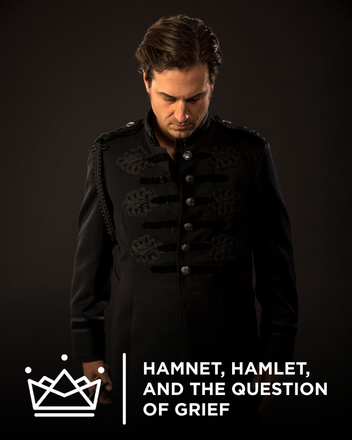
Hamnet, Hamlet, and the Question of Grief
By Kathryn Neves, guest writer
This year, as part of the 65th anniversary season, the Utah Shakespeare Festival will be producing one of Shakespeare’s best loved plays—in fact, one of the best works in the entire English language! Hamlet, often considered the Bard’s magnum opus, is brimming with universal themes. Inaction, legacy, memory, identity, and sanity are all topics that have defined the human experience for millennia. But perhaps the most relatable theme in Hamlet is its exploration of grief and mourning. The play’s many deaths allow us, as an audience, to explore what grief is; what it means to lose someone, the dangers of getting stuck in grief, and how loss can transform a person.
Is it any wonder, then, that so many people see a connection between this play, and Shakespeare’s deceased son, Hamnet?
With the recent release of the film Hamnet, directed by Chloé Zhao and based on the novel by Maggie O’Farrell, the topic of Shakespeare’s life is on a lot of people’s minds. How might his personal tragedy have affected his work? Over the centuries, historians and scholars and fans alike have seen the possible connection between the death of Shakespeare’s son and his best-known play. Most obvious, of course, is the name: “Hamnet” is remarkably close to “Hamlet.” In fact, the neighbor that Hamnet was named after—Hamnet Sadler—often called himself Hamlet. Shakespeare even called him “Hamlet” in his will. The names were practically interchangeable at the time.
Then, of course, there’s the timing. Shakespeare’s son died in August of 1596, likely from the bubonic plague which was sweeping through Stratford (and all of London) at the time. The play Hamlet then appeared only three to five years later; a play which featured the turmoils of grief, and famously, an iconic contemplation of what comes after death. The play also centers around the relationship between a father and son; it is old King Hamlet’s death, after all, that sets the events of the play into motion. It seems like a no-brainer that Hamlet was inspired by the death of Hamnet.
It’s natural to want to find a connection between Shakespeare’s work and his loss. After all, who isn’t curious about his life? We know so little about him and his family. No wonder we try to read Shakespeare himself into every work. But, as interesting as this theory is, the truth is—we don’t really know. Most scholars reject the Hamnet/Hamlet connection; Hamlet is, after all, based on an earlier legend—a legend about a man named “Amleth.” Hamlet is also largely taken from an earlier, lost play (which scholars call the “Ur-Hamlet”), meaning that these themes of loss, grief, and a father-son relationship existed in this form long before Shakespeare lost his son.
If you’re looking for something likely inspired by Hamnet’s death, though, a lot of scholars point to King John. Written in the year after Hamnet’s death, it features one of the most moving depictions of grief Shakespeare ever put to paper. After losing her son, the character Constance says:
“Grief fills the room up of my absent child,
Lies in his bed, walks up and down with me,
Puts on his pretty looks, repeats his words,
Remembers me of all his gracious parts,
Stuffs out his vacant garments with his form;
Then, have I reason to be fond of grief?”
This passage, to many scholars, feels like a more immediate, definite, and obvious response to Hamnet’s death than anything in Hamlet.
Still, whether or not Hamlet was inspired by Hamnet’s death, it’s clear from all of his works that Shakespeare was deeply familiar with grief. Hamlet’s depiction of loss, obsession, and family ties have captivated audiences for centuries. It’s reasonable to think, then, that Shakespeare was writing about his own experience. Even if Hamnet’s death wasn’t consciously on his mind when he wrote Hamlet, it’s fair to say that his own experiences with past grief shaped the play.
Written so realistically, with such universal and relatable language, it’s no wonder that people come back to Hamlet again and again. One of the most commonly performed plays in the English language, it’s been a Festival favorite ever since the opening season in 1961. So this summer, come and see Hamlet running June 19 to September 4, 2026, in the Engelstad Shakespeare Theatre, and see for yourself just how well Shakespeare captures the human experience.
Get your Hamlet tickets here