


News From the Festival
High School Competition Oct. 3–5
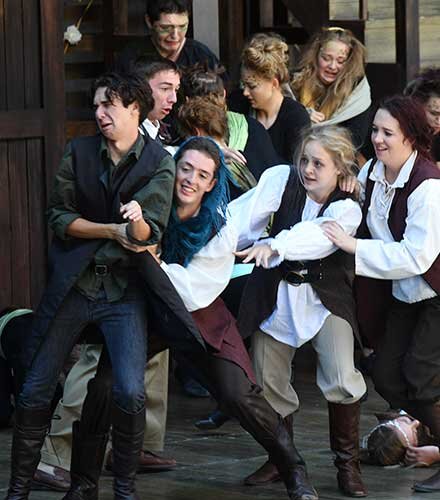
From October 3 to 5 over 3,500 students from more than 130 schools in eight states will descend on the Utah Shakespeare Festival and Southern Utah University as part of the forty-third annual Shakespeare Competition, the largest scholastic Shakespeare competition in the country.
While here, they will compete in acting, dance/choreography, music, and technical theatre before panels of industry professionals. They will also participate in workshops such as stage combat, improvisation, movement, technical theatre, auditioning, ballet, modern dance techniques, and choral performance, as well as attend Festival and SUU plays. At the end of three days, winners will be announced and trophies and scholarships handed out.
“For more than four decades this event has changed the lives of aspiring young students from all over the United States,” said Michael Bahr, Festival education director. “I’m looking forward to continuing this great tradition of theatre, dance, and music.”
Competitors range from sixth grade to high school seniors. Each participating school is invited to prepare monologues, two duo/trio scenes, and ensemble scenes, as well as an interpretive dance, minstrel and madrigal music. Technical theatre students will also compete in the numerous “backstage” areas of theatre, where they will be tested and trained in lighting, audio, set construction, props, rigging, costumes, hair and makeup, and stage management. Performing on Festival stages and in many classrooms on the SUU campus, students are adjudicated by professional actors, directors, dancers, musicians, and artists.
Donn Jersey, director of development communications said, “Anyone attending the Shakespeare Competition will clearly see the passion and exuberance these students demonstrate for theatre, dance, and music. They will be the future leaders of the arts, and this competition gives them the tools necessary to believe in themselves and in their art.”
Further information is available at the Festival website: bard.org/competition.
Hamlet Like You've Never Seen It Before
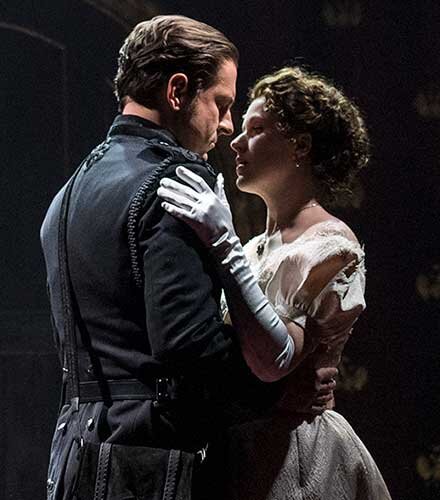
Quinn Mattfeld (left) as Hamlet and Emma Geer as Ophelia.
By Kathryn Neves
Odds are, if you’ve ever visited the Utah Shakespeare Festival, seen The Lion King, or attended a high school English class, you’re familiar with the story of Hamlet. The tale of a Danish prince, a ghost, a murderer, and an impending war is immediately recognizable to millions of people around the world. It is, after all, one of Shakespeare’s best—and most popular—plays.
With that in mind, it might be easy to say, “Oh, I’ve seen Hamlet. I know this story. Why should I go see it again?” The answer to that is simple: you’ve never seen Hamlet like this before. The Utah Shakespeare Festival’s 2019 production of Hamlet, directed by Brian Vaughn and starring Quinn Mattfeld, is an astounding piece of theatre that casts the story of Hamlet in a brand-new light. Whether you’ve seen Hamlet once or a hundred times, it’s worth seeing again for this interpretation. In fact, Russell Warne, reviewing the play for Utah Theatre Bloggers Association, says this production “is endlessly rewarding to watch.”
One of the aspects of this show that especially stands out is its setting. Immediately upon entering the theatre, you can see the signs of Imperial Russia: the costumes, the set, and the snow piled on the stage all work to transport you back to the time of czars and revolutionaries. Vaughn explains that this show is not necessarily “a realistic Russia, but a fictional Denmark similarly woven toward a kingdom under age-old repression, arbitrary rule, and an extreme sense of nationalism—resonating anger, divisiveness, and despair.” The changed setting of the play speaks well to Shakespeare’s universality: the story of a Danish prince seeking to avenge his father feels real and significant in any time period.
Beyond that, Hamlet’s themes of corruption, espionage, and tyranny fit very well in a Czarist Russia setting. “I was very intrigued by Claudius and his appeal to the masses; but, underneath, this is a king who is leading by fear, repressing the truth, and using murder as a tactic to keep the truth at bay,” said Vaughn. The setting “helps isolate the lone figure of Hamlet, trying to discover the truth in this very fictitious landscape. Hamlet is mining for the truth underneath the layered façade.”
But it isn’t only the changed setting that makes this show worth seeing. This production brings the oft-overlooked character of Ophelia (played by Emma Geer) into a much more prominent role. Too often, productions of Hamlet tend to cast Ophelia aside as merely a victim of circumstance, a damsel-in-distress subject to the whims of the powerful men around her. However, in this production, Ophelia takes on more significance—as a confidante, an ally, and a key part in Hamlet’s quest for the truth. “I wanted an Ophelia of great agency, who is deeply in love with Hamlet, and a Hamlet who is deeply in love with her,” says Vaughn. “I wanted an Ophelia who was like Hamlet: intelligent, strong, and curious and who is helping Hamlet expose the truth in this court. Through her madness she exposes those around her to the machinations that they undergo to try to keep her and Hamlet at bay.”
All this, of course, makes Ophelia’s death in the play far more powerful and gives it an entirely new meaning. Without giving too much away, Vaughn’s interpretation shows Ophelia’s drowning as a powerful result of the duplicitous nature of the play’s characters, and even of the play itself. “I wanted to add another layer to this corrupt kingdom,” says Vaughn. “What is truth and what is fiction? . . . Gertrude reports the drowning of Ophelia, . . . and why didn’t Gertrude do anything about it?”
This nuanced and layered Hamlet is enhanced by several of the staging effects. Snow piled across the stage and sometimes falling from the sky creates a striking effect that serves to emphasize the ever-present corruption of the court. It also illustrates the mental state of Hamlet himself. During one of his particularly compelling soliloquies, snow begins to fall from high above the stage. Vaughn explains, “I was very interested in . . . how the elements run in harmony with Hamlet’s vulnerability in that moment . . . it’s one of my favorite moments, as Hamlet is at his most vulnerable, and the snow became a metaphor for the truth that will never leave him. Hence its prescience in the scenic design. It is always present, just like the truth. You can push it to the corner, but it will always be there.”
Rest assured, even if you know Hamlet well, this production will still surprise you. The beautiful stage design, the phenomenal acting, and the overall direction of the show come together to create a Hamlet unlike anything you’ve seen before. The Independent reviewer Brian Passey, agrees; the show “might just be the best version of the Bard’s beloved play you’ll ever see.” And it’s true; you’ll leave the theatre feeling as though you’ve just heard Shakespeare’s immortal words for the very first time.
Living with Hamlet: Part Two
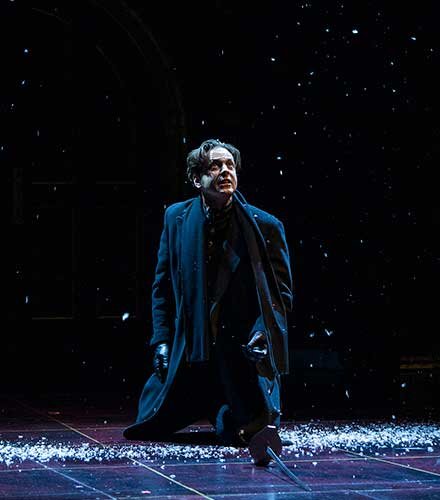
Quinn Mattfeld as Hamlet
By Quinn Mattfeld
Editor’s Note: This is the second of three blog posts written by actor Quinn Mattfeld about playing the towering role of Hamlet this year at the Utah Shakespeare Festival.
An actor’s approach to Hamlet at some point becomes as much about the choices he doesn’t make as about the ones he does. Lawrence Olivier’s 1948 film version begins with the unfortunate prologue, “This is the tragedy of a man who could not make up his mind.” Any such specious definition of Hamlet’s character or the tragedy to which he gives his name is a deadly pitfall that discerning actors ought to guard against in order to avoid imposing limitations on that which is limitless.
“Hamlet is melancholy.” “Hamlet is mad!” “Hamlet is in love with his mother.” Actors are often the recipients and sometimes the perpetrators of these reductive musings on the character’s nature. I believe the first step of any sincere journey toward playing the Dane necessarily becomes weeding out the cultural junk-DNA that so frequently follows in his wake.
The flaw in many of the underlying assumptions about Hamlet have nothing to do with the accuracy of the psychological projections onto his motivations, but rather the fact that those assumptions are static. As with Olivier’s qualitative prologue, what much of the speculation on Hamlet fails to take into account is how he changes—or rather that he changes and with such frequency.
The Hamlet that begins the play is a wholly different creature than the one who ends it. The same is true of Hamlet before he speaks “To be or not to be” and after; as well as before and after “rogue and peasant slave,” “how all occasions,” and “the fall of a sparrow.”
The vehicle underlying Hamlet’s character arc is discovery. Throughout the course of the play Hamlet discovers the nature of his own humanity and the spiritual agency he generates in that process comes in the form of change.
“To be or not to be” transforms in the span of two acts into “let be.” “Am I a coward?” becomes “conscience does make cowards of us all.” What began as a question is ultimately resolved by the undoing of Rosencrantz and Guildenstern when Hamlet declares to Horatio, “they are not near my conscience.” He then further argues that killing Claudius by the means of his own device is “perfect conscience.”
In playing Hamlet, I continue to find these transformative arcs of language throughout the text: “seem,” “beast,” “now,” “no more.” Shakespeare builds these words and ideas into Hamlet’s experience of the world and does not repeat them unless their meaning and significance propels him forward into a new understanding of himself.
The joy of Hamlet is not in playing out an intellectual exercise or pet theory about just any old literary character. The beauty is in the transformative experience of a character who evolves as his story evolves, whose concept of himself is as malleable as the shifting circumstances of the Danish court.
Hamlet’s final state and how he arrives at it are certainly matters of individual artistic interpretation, but the understanding that his character arc is one of continual transformation and self-discovery is probably the best place for an actor to start.
Festival Taking Suicide Prevention Message to Utah Schools

There is a play with a life-affirming message so powerful that the Utah Shakespeare Festival is offering it to every public high school and university in the state of Utah to help stem the tide of youth suicide. Every Brilliant Thing, by Duncan Macmillan with Jonny Donahoe, is an ingenious, heartfelt, highly theatrical one-person show wherein the narrator interacts directly with the audience.
Audience members learn that when the narrator was a child, his or her mother suffered from depression and attempted suicide. The narrator decided to make a list of all the things that make life worth living to persuade her to live, starting with #1, “ice cream,” and continuing to one million. This inventive, beautifully rendered theatrical experience is unique in the way the audience becomes a support community for the narrator and gains rich insights along the way about the things hiding in plain sight that make life worthwhile and wonderful.
“I am proud of the effort undertaken by the Utah Shakespeare Festival to perform Every Brilliant Thing at each school within this great state,” said Lieutenant Governor Spencer J. Cox, who has discussed his own struggles with suicidal thoughts as a young man. “Many youth today do not have adequate support structures and demand our attention and the encouragement from efforts like this. I believe this production will save lives.”
Through the support of the State of Utah, the Department of Heritage and Arts, the Utah Department of Arts and Museums, Rural Health Division of Southern Utah, Southern Utah University, the Ashton Family Foundation, and the Hemingway Foundation, there will be no charge to the schools or students.
Materials and information on how students can get help will be available after each performance.
Two separate touring companies will crisscross the state from October 2019 to February 2020. They will present more than 150 school performances and 10 public performances, reaching over 75,000 students.
“Taking two tours of Every Brilliant Thing around the state of Utah is a public service effort the Festival is proud of,” said Donn Jersey, director of development and communication. “The hope is this endeavor starts a conversation and removes the secrets that can cause suffering so healing can be a real possibility for those affected by depression and suicidal thoughts. We are incredibly grateful to our sponsors for making this dream a reality.”
Utah has the highest rate of suicide for youth ten to twenty-four years old and ranks sixth highest in suicide rates in the nation, according to the Centers for Disease Control and Prevention. Many students in the state have been impacted by suicide in some way, and the state has undertaken a variety of measures to reverse this tragic trend.
“This is some of the most important work we, as a theatre company, can do,” said Frank Mack, executive producer of the Festival. “While it’s not treatment, artistic experiences that so powerfully say ‘yes’ to life can have a profound impact. When we see someone else’s story, it can help us reflect on our circumstances in completely new and different ways. When young people see, in a marvelously creative and theatrical way, one million reasons to live, it will help shed light on what’s most positive. Live theatre can do this like nothing else.”
The Price: It's Just Stuff, Isn't It?
By Kathryn Neves
This season, Arthur Miller’s The Price will give us a glimpse of just what it is to be human. It’s an astounding play full of universal themes and archetypes, but one of the more fascinating subjects that the play addresses is the idea of physical objects—the way we attach emotion to things and materials. Through the characters’ attachment to various items in the play, we get a better look at who they are and the ways that they deal with the complicated relationships they have. This theme raises an interesting question: Why do we attach emotion to things? Afterall, it’s just stuff, isn’t it?
The answer to this can perhaps be found in social psychology. One study argues that this attachment can arise due to insecure personal relationships: “People attach to objects, at least in part, to compensate for the perception that close others are insufficiently reliable sources of security” (Keefer, Lucas A., Mark J. Landau, Zachary K. Rothschild, and Daniel Sullivan, “Attachment to Objects as Compensation for Close Others’ Perceived Unreliability” [Journal of Experimental Social Psychology 48, 2012], 912). This idea comes through pretty clearly in The Price. Throughout the play, we learn that Victor, a policeman who regrets not attending university, resents nearly everyone in his life—most especially his brother Walter and his late father. Though Miller doesn’t say as much, it’s clear that the emotional attachment most family members have with each other is absent in this particular family. Near the end of the play, Walter proclaims: “All that is standing between us now—an illusion. . . . I only saw then what you see now—there was nothing here to betray. . . . It is all an illusion and if you could walk through it, we could meet” (Miller, 438). It becomes obvious throughout the play that the family dynamic was and still is dysfunctional. We learn of different lies and betrayals, we learn old family secrets, and we see age-old resentments that have torn the family apart.
Keefer et al. claim that “people whose attachment figures consistently reject them in times of need may learn that relying on others is not an effective way to manage distress. People typically respond to this situation with attachment avoidance: maintaining independence and emotional distance from close others to avoid rejection” (912). Again, we can see this in Victor and Walter. Because each of them feels he cannot rely on the other, each has spent years without speaking to each other, trying to live completely independent of each other. This leads them to bond with the furniture and other objects in their father’s house.
“Attachment to material objects can similarly serve to compensate for the threat to attachment security posed by close others’ perceived unreliability” (913). In other words, the items that Victor and Walter are trying to sell have become substitutes for real familial love. Victor explains it himself early on in the play: “This whole thing— it hit me like some kind of craziness. Piling up all this stuff here like it was made of gold. He half-laughs, almost embarrassed. I brought up every stick; damn near saved the carpet tacks” (Miller, 360).
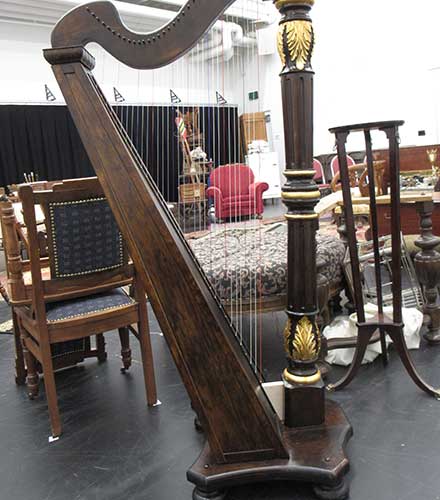
As Victor and Walter prepare to sell their parents’ old belongings, there are several items that seem to take on a greater meaning as the play goes along. Their mother’s harp and their father’s chair are particularly important in the script. It’s almost as though each of those items has come to represent the family as it used to be, and the relationships that the family used to share. For instance, Miller focuses a lot on the harp throughout the play. Both in dialogue and in stage directions, it’s clear that the harp is more than just a harp—it’s a representation of their deceased mother, and an embodiment of old relationships that have either completely changed or been destroyed altogether. “My mother’d play for hours down in the library,” Victor says, “Which is peculiar, because a harp is so soft. But it penetrates, I guess” (Miller, 363). Victor and Walter both speak of the harp with a certain reverence, as though they’re remembering not just the harp, but all the memories and associations that surround it. However, even though the harp is clearly important to each of them, the object itself is not enough to make up for the emotional distance they have with their family Victor explains: “It’s odd. . . . Like the harp! I can almost hear the music. . . . But I can never see her face. Somehow. For a moment, silence, as he looks across at the harp” (Miller, 409).
Even more poignant than the harp, however, is the way that Miller treats their father’s chair throughout the script. Nearly every time someone references their late father, they point to his empty chair. The stage directions are littered with references to it. As much as the harp represents the insecure emotional attachment to their mother and their childhood in general, the father’s chair does it even more. Toward the end of the play, we learn a dark family secret about the father that has been haunting each brother for their entire lives, and the chair becomes emblematic of that insecurity. Because of their father’s secrecy and deception, neither Walter nor Victor could truly have a reliable relationship with their father: instead, these feelings of emotional attachment transferred over to the objects and the furniture kept in the old house— especially their father’s chair. Many of Walter’s lines demonstrate this really well: “I wasted thirty years protecting myself from that catastrophe. He indicates the chair: And I only got out when I saw that there was no catastrophe, there had never been” (Miller, 438). Victor even addresses the chair at one point, further solidifying the chair as a substitute for his actual father. A stage direction says “He stops; his stare is on the center chair, caught by memory; in effect, the last line was addressed to the chair” (Miller, 438).
Walter and Victor spend the play unable to truly connect with each other emotionally. Instead, they are stuck in old patterns of emotional insecurity and unreliability. Instead of connecting with each other as brothers, they—especially Victor—hold on to the sentimental attachments they have with the furniture and objects in their parents’ old home. Their refusal to face the past and instead attach themselves to material items is a poignant point that Arthur Miller makes through the play: as humans, we have a tendency to avoid emotions and relationships, and instead turn our attentions to the physical world, putting too much value on things. In the end, the character Gregory Solomon says it best: “With used furniture you cannot be emotional” (Miller 371).
Arthur Miller: An American Master
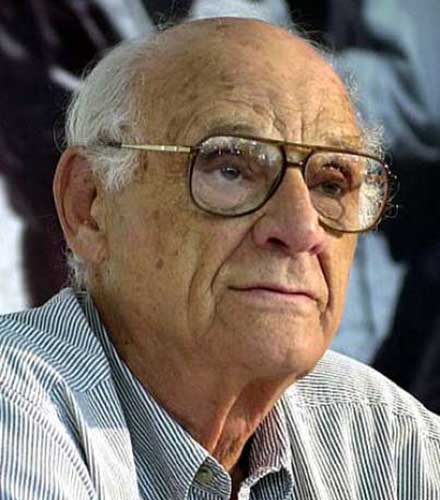
Playwright Arthur Miller
By Kathryn Neves
This isn’t the first time the Utah Shakespeare Festival has produced an Arthur Miller play. The 1991 season saw Death of a Salesman in the Randall L. Jones Theatre. Death of a Salesman is arguably Arthur Miller’s most famous play, but many people would argue that everything Arthur Miller wrote was a masterpiece. He was, after all, one of America’s greatest writers. So as we produce one of his lesser known works this season, The Price, it might be good to understand a little more about the man and the context in which he wrote his plays.
The Price, though many people haven’t even heard of it, is a stunningly beautiful piece of theatre. After opening on Broadway in 1968 it was nominated for two Tony Awards. “The Price is one of the most engrossing and entertaining plays that Miller has ever written. It is superbly, even flamboyantly, theatrical” (Clive Barnes, “Theater: Arthur Miller’s ‘The Price’” [The New York Times, 2/8 1968]). It’s the story of two brothers, a wife, and an antiques dealer coming together after years apart to sell their late father’s belongings. Through the eyes of these characters, we see the results of old family grudges and prejudices, and we ultimately learn the ways in which they do, and they don’t, reconcile. The now deceased father, once a very wealthy man, lost everything in the Great Depression, and his sons, decades later, have to deal with the ramifications of the loss, deception, and resentment in their family.
This isn’t an autobiographical piece; Arthur Miller’s work is mostly fiction. Still, if you look closely at the characters and events in this play and others, it’s pretty clear that Miller used concepts from his own life to enrich his work.
Miller was born in 1915, the son of a Polish Jew who moved to America during the Jewish pogroms of the Russian Empire. His family owned a coat-making business, but when the Great Depression hit, all the Millers had to give up and move. Miller then began working in a bakery to help support his family. This is remarkably similar to an important character in The Price, Victor Franz. As the play goes on, we learn that he once had dreams of becoming a doctor and a scholar, but after the Great Depression he ended up becoming a police officer in order to support his poor, incapacitated father. There are similar themes of father-son dissatisfaction, poor economy, and work ethics in his other plays too, most notably Death of a Salesman.
But it’s not only Miller’s personal life that’s mirrored in his work; the events of his world— historical moments, great figures, and political movements— made their way into his works as well. And it’s not just The Price— you can see it in many of his other plays. The Crucible is a great example; written in 1953, it showed the story of the Salem Witch trials through the eyes of a few fictional characters. The story went deeper than that, though. It was actually an allegory for the Red Scare and the Communist “witch hunts” conducted by Senator Joseph McCarthy. Interestingly enough, Miller himself was brought before the House of Un-American Activities Committee just three years later and was investigated for his supposed Communist leanings.
His play All My Sons revolves around family loss and trauma after the events of World War II, and the ways in which people come to terms with the casualties of war. Death of a Salesman deals with economic complications and individual responses to disastrous events around them— i.e., the Great Depression. The list could go on for quite a while.
All in all, Arthur Miller’s works are more than just fiction; they are reflections of the author himself, and of the tumultuous events of the history that he lived through. By watching his plays, we can understand more about not just Arthur Miller, but about the world itself. Take the chance the summer to see The Price. This complex masterpiece is just one example of Arthur Miller’s genius, brilliance, and amazing understanding of the human condition.
Living with Hamlet: Part One
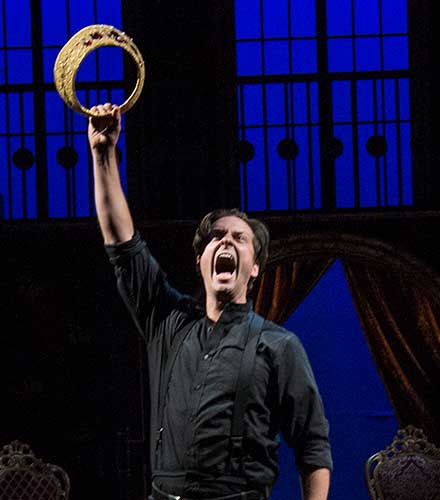
Quinn Mattfeld as Hamlet
By Quinn Mattfeld
Editor’s Note: Over the next few weeks, actor Quinn Mattfeld will be writing blog posts about what it is like to play the role of Hamlet. This is the first of three such posts.
As an actor, what can I say about Hamlet that hasn’t already been said (and far better) by countless literary critics, theatre critics, philosophers, poets, et. al.? Surely, if there is a way to think of or articulate Hamlet, it has been thought and articulated long before I even knew the play existed. But one of the many beautiful things about being a Shakespearean actor is that we know these plays were intended to be heard not read. In fact, the only people who were ever supposed to have read the plays were actors.
So while the play, as it exists on the page, has been poured over for nearly half a millennium by legions of analytical minds far superior to my own, as an actor I know that there is a difference between reading Hamlet, and living with Hamlet.
Four times a week for almost four months this summer, I have the unparalleled privilege and honor of playing the greatest character in Western literature for thousands of people. For the next few months, as I have for the last few, I will live with Hamlet.
Though this is my third time playing the role, I have learned exponentially more this time through. Every production of Hamlet is different. And every performance within that production is also a new and different experience for an actor (and the audience).
Our job as actors, as is the task with any ritual, is to perform an action for the thousandth time as if it were the first. What naturally emerges from such a prolonged level of intensity and investment is a kind of spontaneous creative impulse within the framework of the story. In those places where I expect to find myself laughing, I may instead find myself moved to tears and vice versa. Often a word will leap into my ear in a way that gives it a depth and resonance it never previously had. A look, a gesture, a movement emerges or fades in some way unexpected but perfectly appropriate for this Hamlet, on this day and no other.
This is what it means to live with Hamlet.
All of these experiences are teaching me that this role, perhaps more than any other role in the canon, cannot be confined to the character as it exists on the page. Hamlet is a perpetual unfolding of revelation. The play begins with a question. The word “question” itself appears more in Hamlet than any other Shakespeare play. The character and the play itself are a relentless search for truth and so to live with Hamlet is to live between spiraling pillars of doubt and discovery.
It is a journey of intimacy and investigation that even the most brilliant scholars will never know unless they step into Hamlet’s boots and experience it for themselves.
Living with Hamlet is the kind of journey that every actor dreams of taking, a journey I look very much forward to continuing into the fall.
We Appreciate Our Soldiers

The Utah Shakespeare Festival will be celebrating our Armed Forces with free tickets for military personnel to selected performances on August 26 to September 3. The Festival appreciates the sacrifices of the men and women who serve and recognizes their dedication and commitment to this country.
The offer is for anyone with a military ID, active or veteran, and includes four tickets per ID total to any of the following shows (all begin at 8 p.m.): Every Brilliant Thing on August 26, The Conclusion of Henry VI: Parts Two and Three on August 28, The Book of Will on September 2, Joseph and the Amazing Technicolor Dreamcoat on September 3, Hamlet on September 5, and Macbeth on September 6.
Military personnel are invited to reserve tickets by calling 800-PLAYTIX or visiting the ticket office near the Anes Studio Theatre. A valid military ID will be required to pick up the tickets, and there is a limit of four tickets per ID. Tickets are not available in the Premier seating section. Space is limited for this special offer, so call soon to reserve your seats.
“I’m honored to be the son of a proud Vietnam veteran,” said Donn Jersey, director of development and communication, “and once again the Utah Shakespeare Festival wants to extend a warm welcome and humble thank you to all of those that made sacrifices to our country and every one of us.”
Regular tickets for the Festival’s 2019 season are still on sale. The Conclusion of Henry VI: Parts Two and Three runs through August 31. Twelfth Night, The Book of Will, and Macbeth continue in the Engelstad Theatre through the weekend of September 5–7. Joseph and the Amazing Technicolor Dreamcoat, Hamlet, and Every Brilliant Thing continue through October 12; and the Festival’s last show of the season, Arthur Miller’s The Price, opens September 12 and plays through October 12. For specific days and times and to purchase tickets, visit www.bard.org or call 1-800-PLAYTIX.
"The King" Is Back
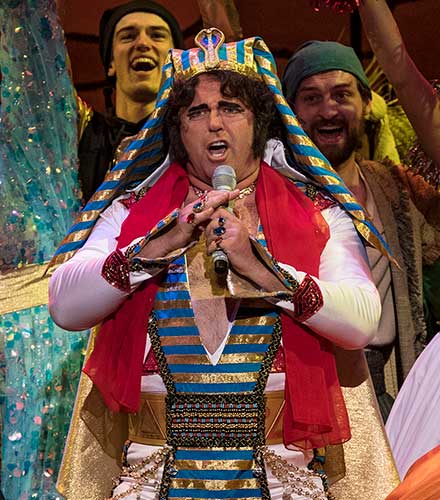
Russ Benton as the Pharoah
By Kathryn Neves
There are countless reasons to come and see Joseph and the Amazing Technicolor Dreamcoat this season: song and dance, fun characters, and a universal story that everyone can relate to. But there’s one particularly compelling reason to come to Cedar City and see this show: the character of the Pharaoh, a.k.a. Elvis, the King himself, played by fantastic actor Russ Benton.
Watching Russ onstage is an awesome experience in its own right, with his great voice, a talent for ’50s style rock-’n’-roll dance moves, and an Elvis impression fit to beat any of the Kings in Las Vegas chapels and hotels. But there’s an added benefit to seeing Russ as the Pharaoh. This is Benton’s second time playing the Pharoah/Elvis: in the Utah Shakespeare Festival’s first production of Joseph, directed by Fred Adams in 1998, Russ was— you guessed it— a much younger Pharoah, a young version of Elvis.
“Now I am the old man in the show, but back then we were all young and full of energy,” said Benton. “I was a much younger man when I played it last. So the idea that [Pharaoh] is an aging rock star this time around makes it much more fun to play now.”
Those who have seen the show will know that it’s no small feat to play the Pharaoh. The amount of energy it takes to wear the Elvis jumpsuit and do the famous swivels, splits, and air guitars is frankly astounding. But it certainly pays off: audiences scream and cheer when Benton goes into his routine.
“It is certainly more difficult to put out the kind of energy and moves that I used to, but that makes it all the more funny now. I enjoy playing with the idea that, although [Pharaoh] believes he can, he really can’t keep up. . . . He is just an absolute narcissist, and despite his execution of the number, still sees himself as godlike,” says Benton. His zany characterization of the beloved character has audiences in stitches every performance.
Audiences who got the chance to see Joseph twenty years ago remember the production with great fondness— and so does Benton. “My strongest and fondest memory was getting to work with Fred Adams, a man who has been a teacher, director, and friend for so many years,” he said. “We had an absolute blast finding the funny moments in the show.”
His love for this show continues to this day. “I’ve really enjoyed working with the director, Brad Carroll,” he says, “and really trying to make sure that, although we have fun, we really pay respect to the story and find our way to the funny through that. . . . I really love this team and cast, and I find their creativity and energy remarkable.”
All in all, Joseph and the Amazing Technicolor Dreamcoat is definitely worth seeing this season. Whether you’ve seen it once or a hundred times, there’s always something new to be learned, something new to enjoy. “It’s a story of family, forgiveness, and redemption. I think that speaks a lot to people,” says Benton. “It’s just great fun, with great music and lyrics that are so catchy and fun to listen to and sing along.” So, drop in and catch on of Lloyd Webber’s finest this year— and keep your eyes peeled for a familiar Festival face!
The "Genesis" of Joseph and His Dreamcoat

Hilary Alexa Caldwell (left) as Rachel, Aaron Young as Joseph, and Michael A. Harding as Jacob.
By Kathryn Neves
Joseph and the Amazing Technicolor Dreamcoat is one of musical theatre’s most popular shows. And it’s no wonder: with fun music, great lyrics, and zany characters, it’s a show not easily forgotten. But more than that, the story of Joseph is something that resonates with many people. After all, at its core, Joseph and the Amazing Technicolor Dreamcoat is a biblical story, passed down century after century. It is a story of family, mistakes, and forgiveness. And Joseph himself is an important figure in several of the world’s major religions; his story is familiar to many people across the globe. So what is the real story of Joseph?
Well, in truth, Andrew Lloyd Webber’s musical does a pretty good job of telling the story accurately, at least according to scripture. Here’s a quick rundown: Joseph is one of the twelve sons of Jacob (otherwise known as Israel). And even though he’s toward the younger end of the litter, he is Jacob’s favorite son, the first son of his favorite wife. So, he gets the birthright, and Jacob gives Joseph a colorful coat to signify his importance. Beyond that, Joseph has prophetic dreams that seem to imply his superiority over his brothers. This doesn’t sit well with them, and they sell him into slavery. Joseph is taken to Egypt, where he moves from place to place and master to master—from a large and important household, to prison, and finally to the Pharaoh. Here, his ability to decipher prophetic dreams comes in handy and saves him from the life in prison. He interprets the Pharaoh’s dreams, and is promoted to the position of vizier— essentially the most powerful man in Egypt besides Pharaoh himself. Joseph leads Egypt through a time of famine, reunites with his brothers and father (after testing their loyalty), and they all move to Egypt to be together with Joseph and be saved from famine.
Joseph was originally from Canaan, which is in modern-day Palestine, Syria, and Israel. According to the Bible, he invited his family—jealous brothers and all—to live with him in the Pharaoh’s household; thus starting the years of Israel in Egypt. Interestingly, it’s said that he asked his descendants to bring his bones back to Canaan if they ever left Egypt. So, according to the Bible, Moses brought Joseph’s remains back to Sechem— modern-day Palestine— where they remain to this day. In fact, there is a funerary monument there today that is a sacred site to many religions.
As the vizier, Joseph would have had immense power. Although there are no records (beyond scripture) of a vizier named Joseph from this time period, there are some interesting pieces of historical evidence that corroborate parts of the story. For one thing, there is evidence of a drought in Egypt around the time of the story. For another, during this time period “a canal was built to keep the ranches of the Nile permanently open, enabling water to . . . keep the land fertile . . . in Arabic it’s the Bahr Yusef. This translates into English as The Waterway of Joseph” (“Joseph,” Religions: Judaism, [BBC, 2009]). It’s possible that Joseph built the canal as part of his plan to save Egypt from the famine.
Practicers of Christianity, Islam, and Judaism all revere Joseph as a prophet, as well as the father of important bloodlines. In Judaism, he’s known as the figure who initially brought the tribes of Israel into Egypt. In Christianity, he is considered to be a symbol, or type, of Christ. In Islam, it’s said Muhammed declared that Joseph was incredibly handsome, receiving half the beauty God apportioned for mankind. Beyond that, throughout the centuries Joseph’s story has provided an example of morality and faith for religious people to follow.
This is why the story has endured for so long. Whether you revere Joseph as a prophet or just want to watch Andrew Lloyd Webber’s musical, Joseph’s story is universal. Themes of jealousy, love, loyalty, and above all, family, resonate with everyone—whether read from the Bible or seen from the stage. “The story of a boy whose dreams came true” appeals to us all—because “it could be you.”
Joseph and the Amazing Technicolor Dreamcoat plays through October 12 at the Festival. Tickets are available by calling 800-PLAYTIX or at www.bard.org.